The evolution of Metal Castings in industrial manufacturing
Wiki Article
Key Advantages of Using Steel Castings Throughout Various Markets
Metal spreadings function as an important component in numerous industries, supplying distinct benefits that enhance performance and performance. Their style adaptability enables detailed shapes, while their material homes add to overall longevity. Cost-effectiveness and sustainability further highlight their relevance in modern production. As industries remain to evolve, comprehending the complete extent of benefits offered by steel spreadings becomes vital for critical decision-making. What implications do these advantages hold for future advancements?Boosted Design Versatility
Although standard production methods frequently impose restrictions on layout intricacy, steel spreadings offer amazing versatility that allows complex forms and attributes. This adaptability allows developers to develop parts that would certainly be tough or difficult to accomplish with other techniques. The spreading procedure, which entails putting molten metal into mold and mildews, can suit a range of geometries, making it appropriate for diverse applications ranging from auto to aerospace.The capacity to generate both small and large components with in-depth designs boosts the general performance of the items. Developers can optimize weight and efficiency by incorporating complex inner structures, such as cooling networks or support ribs (Aluminum Foundry). Furthermore, metal spreadings can facilitate the unification of several features right into a single component, reducing the demand for assembly and decreasing prospective factors of failure. Subsequently, the improved layout versatility of steel spreadings not only cultivates advancement but likewise adds substantially to performance in manufacturing processes
Boosted Material Qualities
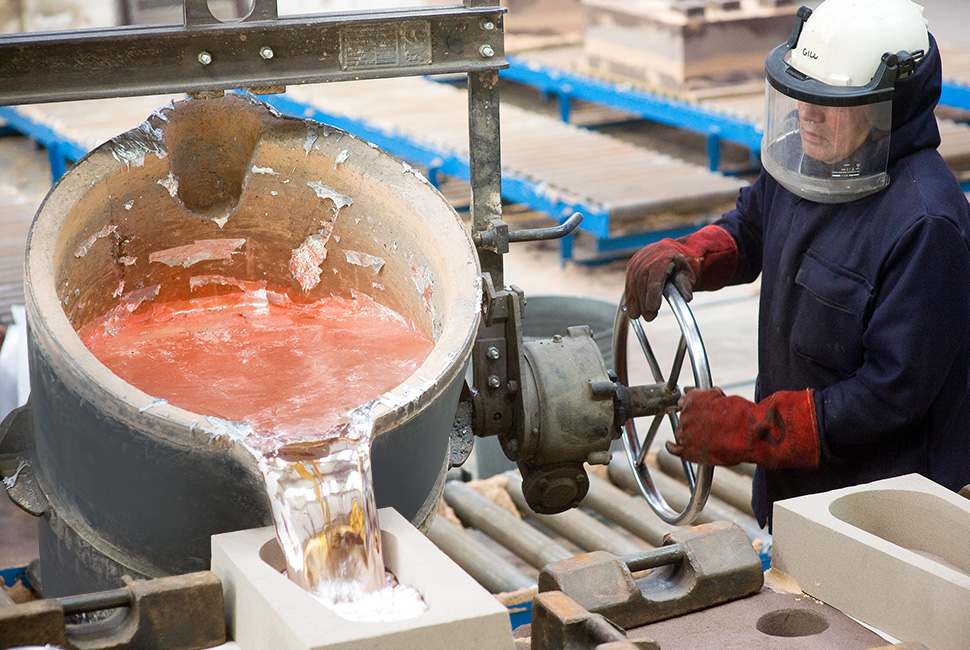
When thinking about the benefits of steel spreadings, among the most significant advantages depends on their enhanced material residential properties. Steel spreadings commonly display boosted toughness and toughness compared to other making techniques. This enhanced strength is credited to the controlled air conditioning procedure during spreading, which enables for an uniform microstructure. Therefore, cast metals can withstand greater levels of stress and anxiety and tiredness, making them perfect for requiring applications.
Furthermore, metal spreadings offer premium rust resistance, specifically when alloys are utilized to enhance efficiency in harsh settings. This characteristic prolongs the life-span of elements and lowers the need for regular substitutes. Furthermore, the capacity to create complicated forms without compromising architectural honesty further improves the functionality of cast components. Sectors ranging from automobile to aerospace benefit from the durable and dependable nature of steel castings, making sure peak efficiency and safety in their applications. Security Cost-Effectiveness and Minimized Waste Steel castings present a considerable benefit pertaining to cost-effectiveness and decreased waste, matching their improved material properties. Conventional production methods commonly call for extensive machining and finishing procedures, which can create substantial scrap product and sustain high labor prices. In comparison, steel spreading enables the manufacturing of intricate forms in a solitary process, reducing the need for additional processing and decreasing material waste.
Moreover, metal casting makes use of mold and mildews that can be recycled several times, even more lowering production prices with time. The capacity to cast detailed styles additionally indicates that suppliers can achieve higher style versatility without endangering on quality, therefore staying clear of expensive redesigns. In general, the cost-effectiveness of metal castings not only benefits makers by reducing expenses but likewise supports sustainability efforts by decreasing waste. This double benefit makes steel spreadings a recommended selection across different fields, consisting of vehicle, aerospace, and construction
Enhanced Production Effectiveness
Boosted manufacturing performance is a considerable advantage of metal spreadings, as it promotes streamlined manufacturing processes. By enhancing these processes, business can successfully lower product waste and attain faster turn-around times. This combination not only enhances productivity but likewise adds to general operational excellence.
Streamlined Manufacturing Processes
As producing demands develop, the fostering of structured procedures becomes necessary for enhancing production effectiveness. Steel spreadings play a critical duty in attaining this goal by helping with quicker production cycles and reducing preparations. Their intrinsic style adaptability permits suppliers to generate complex shapes with marginal setting up requirements, therefore streamlining workflows. Advanced spreading strategies, such as precision spreading and 3D printing, add to greater precision and uniformity, more maximizing procedures. By integrating metal castings into producing processes, companies can attain greater automation, which minimizes manual intervention and increases throughput. Streamlined procedures not only boost productivity yet likewise make it possible for producers to react swiftly to market adjustments, ensuring competition in an increasingly dynamic landscape.Decreased Product Waste
Lowering material waste is a vital benefit of using steel spreadings in manufacturing. This procedure permits for near-net-shape production, where parts are developed with very little excess product. By using metal casting strategies, manufacturers can significantly reduce the quantity of scrap generated compared to standard machining approaches. Consequently, this reduction in waste not just preserves raw materials but likewise lowers costs associated with product purchase and disposal. Furthermore, much less waste adds to more sustainable manufacturing methods, lining up with ecological goals. The effectiveness accomplished via steel castings improves total manufacturing processes, enabling business to enhance source use while maintaining high quality criteria. This critical approach inevitably brings about improved financial performance and a minimized ecological impact, benefiting both producers and society at huge.Faster Turnaround Times
Faster turnaround times stand for a noteworthy benefit in the domain of metal castings, improving overall production effectiveness. By enhancing the spreading process, makers can considerably reduce preparations, permitting for quicker delivery of finished products. This efficiency is particularly important in industries that demand quick feedback to market adjustments, such as aerospace and vehicle markets. The capability to create components swiftly not just satisfies client expectations yet likewise reduces downtime in manufacturing lines. In addition, improvements in technology, such as boosted mold and mildew style and automation, add to these expedited procedures. Faster turnaround times in metal casting not only reinforce functional result but likewise give an affordable edge, enabling firms to respond quickly to advancing customer requirements and minimizing the threat of obsolescence.Superior Strength and Longevity
While various materials complete for preeminence in manufacturing, metal castings continually demonstrate exceptional stamina and longevity, making them an excellent selection for countless applications. The inherent buildings of metals, such as their high tensile toughness and resistance to put on, ensure that spreadings can hold up against extreme functional conditions without failing. This longevity translates right into longer solution lives for components, lowering the frequency of replacements and maintenance.Furthermore, the capability to create intricate geometries with metal castings allows suppliers to make parts that maximize toughness without adding unnecessary weight. This is especially helpful in industries that prioritize efficiency and effectiveness, such as aerospace and auto. Furthermore, metal castings display exceptional resistance to extreme temperature levels and corrosive atmospheres, boosting their applicability in challenging settings. Generally, the premium toughness and sturdiness of steel castings position them as a fundamental material in design, adding to the integrity and durability of various products and Aluminum Castings systems.
Flexibility Across Industries
The integral stamina and sturdiness of metal castings make them a functional option across a wide variety of markets. From automobile production, where precision-engineered elements are vital for efficiency and security, to aerospace, where lightweight yet robust components are vital for trip, steel castings play a considerable role. In the building industry, castings are used in building elements and structural frameworks, making certain longevity and security. The energy industry utilizes metal spreadings in machinery and equipment, assisting in efficient operations in power generation and renewable power systems. Furthermore, the clinical field take advantage of custom castings utilized in medical tools and tools, highlighting the requirement for dependability. This adaptability enables suppliers to meet unique specifications and governing needs, improving product performance and efficiency. Generally, the versatility of steel castings places them as a very useful source throughout different markets, driving innovation and effectiveness.Payment to Sustainable Practices
Steel spreadings play a considerable duty in advertising sustainable techniques with their source recycling performance. By lessening waste generation and applying energy conservation techniques, the spreading process demonstrates a dedication to environmental responsibility. This method not only benefits makers however likewise contributes positively to the more comprehensive ecosystem.Resource Recycling Performance
Stressing source reusing effectiveness, metal castings play an important role in sustainable techniques by lowering waste and reducing the demand for new resources. The procedure of reusing metals is highly reliable; it permits the reuse of scrap materials, which can be melted down and changed right into new spreadings. This technique not only conserves power however also minimizes ecological effect by reducing the need for mining and removal activities. Additionally, recycled steel keeps its inherent residential or commercial properties, ensuring that the top quality of castings remains high. This way, markets that incorporate recycled steels contribute substantially to a circular economy, advertising sustainability while at the same time lowering expenses related to resources procurement. Wisconsin Aluminum Foundry. This efficient use resources exhibits a dedication to environment-friendly manufacturing techniquesDecreased Waste Generation
Reducing waste generation is a necessary aspect of advertising sustainable methods within the steel casting market. By maximizing production strategies and utilizing sophisticated modern technologies, producers can markedly lessen scrap and defective materials. Methods such as accuracy casting and near-net shape procedures enable better material use, straight reducing the volume of waste created. In addition, the incorporation of recycled metals right into the spreading procedure not only lowers the demand for virgin products yet also contributes to a circular economic climate. This strategy aligns with environmental policies and customer assumptions for lasting practices. As a result, minimized waste generation not just profits the setting yet also improves functional performance, inevitably leading to cost financial savings for firms in numerous fields leveraging steel spreadings.Power Conservation Approaches
Enhancing power consumption is an essential element of sustainable methods in the metal casting sector. By executing innovative innovations and approaches, such as regenerative furnace and energy-efficient furnaces, business can markedly minimize power usage throughout production. Furthermore, making use of computer-aided design (CAD) software application makes it possible for precise modeling, reducing product waste and power expenditure. Utilizing scrap steel reusing further saves energy, as it needs much less power compared to generating brand-new steel. Sector leaders are significantly embracing renewable resource sources, such as solar and wind power, to mitigate their carbon footprint. These power conservation approaches not just enhance functional effectiveness but additionally add to the general sustainability of the metal spreading market, lining up with international environmental objectives and lowering reliance on nonrenewable fuel sources.Frequently Asked Inquiries
What Industries Most Generally Use Steel Spreadings?
Industries that commonly utilize metal spreadings include auto, construction, aerospace, and production. These sectors depend on steel spreadings for generating components that need precision, sturdiness, and stamina to satisfy their functional needs and requirements.How Does Metal Casting Compare to Various Other Production Processes?
Steel casting uses advantages such as design flexibility and facility form development, identifying it from other manufacturing processes. Unlike machining, it efficiently generates large quantities, making it optimal for various industries requiring long lasting components.What Sorts of Metals Are Usually Utilized in Castings?
Usual steels made use of in spreadings consist of light weight aluminum, iron, steel, and bronze. Each metal uses distinct residential properties, making them appropriate for various applications in industries such as auto, aerospace, and building, to name a few.Exist Any Ecological Problems With Metal Spreading?
Ecological worry about steel casting include air and water contamination from emissions and waste, energy usage, and source depletion. Lasting practices, such as recycling and utilizing cleaner modern technologies, can mitigate these adverse effects in the sector.Just How Can I Select the Right Spreading Technique for My Project?
To pick the appropriate spreading technique, one must think about variables such as the product kind, intricacy of the layout, production quantity, budget restrictions, and wanted surface area finish, guaranteeing alignment with task demands and goals.Metal castings provide a significant benefit concerning cost-effectiveness and decreased waste, enhancing their boosted material homes. Advanced spreading strategies, such as precision spreading and 3D printing, contribute to greater accuracy and consistency, additional optimizing operations. Lowering product waste is an important benefit of using metal castings in production. Stressing resource reusing efficiency, steel spreadings play a crucial duty in sustainable methods by lowering waste and lowering the need for new raw products. Additionally, the incorporation of recycled steels right into the casting procedure not only lowers the need for virgin products yet likewise contributes to a round economic climate.
Report this wiki page